
HOW TO TURN GARMENTS INTO A
MASTERPIECE WITH AI

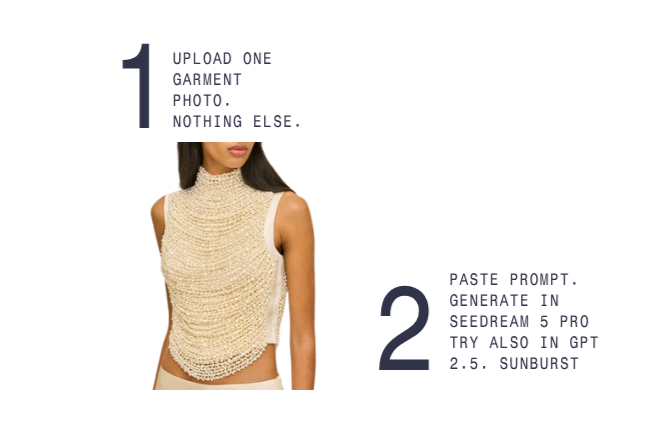
REFERENCE ROLE — The reference image supplies the garment only: silhouette, proportions, construction, collar, closure, sleeve length, seams, trims and colour. Its camera angle, background, lighting, cropping and surface finish carry nothing into this painting.
SUBJECT LOCK — An original oil painting on canvas: a single garment from the reference image hanging empty on a wooden hanger against a floral wallpapered wall. No people, no bodies, no hands. The painted surface fills the frame edge to edge — no frame, no mount, no wall around it.
FORM / SHAPE — The garment's silhouette, proportions, construction, collar, closure, sleeve length and seams taken from the reference image. It hangs on a plain wooden hanger whose hook rises above it near the top edge of the frame, the shoulders draped over the hanger's arms and slumping slightly at the ends. The garment falls open and empty under its own weight, front facing the viewer, symmetrical but not rigid, sleeves hanging slack and lifeless with soft creases where the fabric folds. Centred, occupying roughly the middle two thirds of the frame height, with the hem falling free above the bottom edge.
MATERIAL / SURFACE — Oil on medium-tooth linen canvas, painted thin but fully covered. Every square millimetre of the canvas carries pigment: the weave reads through the thin paint, never as bare exposed ground. The brush is soft and lightly loaded, spreading and blending colour across the surface in continuous strokes rather than depositing it. Delicate, economical handling: each area resolved in a few soft passes, then left alone. Only three or four small touches of slightly thicker paint in the entire picture — the light on the collar, a shoulder edge, one button. Every edge soft, feathered and painted, never outlined and never sharp. The wall behind is broad, continuous and softly modulated — brushy and slightly uneven in tone, but opaque and unbroken.
COLOR — Cool and quiet, narrow value range, low chroma. The wall in soft eau-de-nil green, modulated, holding the whole picture. Scattered across it, small wallpaper sprigs in dusty rose, coral, soft yellow and sage green, each one a few soft marks with generous empty wall between them — spaced, airy, never a dense repeating print, and partly hidden behind the garment. The wooden hanger in warm honey-tan, the only warm note. Shadows are made by mixing each area's own colour with red, never with grey or black. Highlights are soft strokes of warm white on the collar and shoulder. The garment keeps the exact colours of the reference image at their true strength — read every colour off the reference and reproduce it faithfully, hue for hue, on the fabric, the trims, the buttons and any pattern or beading. Do not warm them, mute them, lighten them or shift them toward the palette of the wall. If the garment's colour would clash with the eau-de-nil wall, change the wall to a soft warm cream instead and keep the garment exactly as it is.
DETAILS — Buttons, stitching, collar edges, trims and any pattern on the garment suggested with small soft marks, never drawn as individual objects and never modelled in relief. Wallpaper sprigs painted as loose dabs of colour with a few green strokes for leaves — recognisable as flowers only at viewing distance. Cast shadow soft and narrow, falling on the wall to the camera-right side of the garment and hanger, painted as the wall's own green shifted warmer and darker, no hard edge and no dark core.
SETTING / ENVIRONMENT — A flat floral wallpapered wall filling the whole frame. Nothing else in the picture: no furniture, no rail, no floor, no horizon.
LIGHTING — One soft diffuse source from the upper left of the frame. Gentle separation, shadows open, no gloss, no rim light. Matte throughout.
CAMERA — Reproduction of the painting shot flat and square on, sensor parallel to the canvas, 50mm, f/8, the weave and the thin brushwork fully legible corner to corner. Square, 1:1.
STYLE / MOOD — Narrative oil painting, still life, thin, delicate, quiet, restrained.
NEGATIVE CONTROL — No people, no bodies, no mannequin, no hands, no filled or worn garment, no stiff or ironed garment, no dense or repeating wallpaper pattern, no busy background, no bare or exposed canvas, no unpainted patches, no dry-brush skips or gaps between strokes, no impasto, no thick paint, no raised ridges, no visible paint relief, no palette knife, no sculpted or modelled buttons, no recolouring of the garment, no desaturating or warming of the garment's own colours, no shifting it toward the palette of the wall, no photorealism, no photographic rendering, no digital or airbrushed surface, no outlined shapes, no sharp edges, no black, no cool grey shadows, no flat unmodulated wall, no gloss or specular highlight, no floating garment, no visible canvas edge, no frame, no mount, no gallery wall, no signature, no text, no watermark.
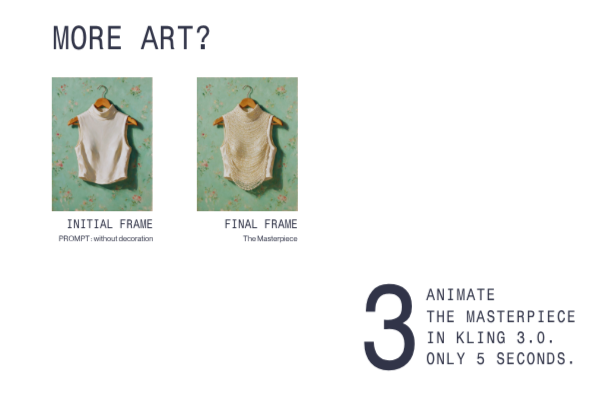
The decoration appears gradually, as if a painter were laying it down stroke by stroke. Small touches of colour show up directly where each detail belongs, scattered across the product at once, never travelling across the surface and never growing outward from any point. More touches land in the gaps between them until the product matches the final frame exactly — every ornament in its place, none invented and none missing. Each mark arrives as wet paint settling into place, never as a solid object dropping in. Once a mark is down it stays exactly where it is; only its highlight brightens as the picture finishes.
The product stays in exactly the same position and does not move, swing or rotate. Where the decoration adds bulk, the silhouette fills out slightly as the marks accumulate; nothing else about the shape changes. The background, the cast shadow and the light stay unchanged. The canvas weave and the brushstrokes of the painting itself do not move.
Camera static.
Painted, not grown. Flat marks appearing in place. Slow, painterly.